
The Poisson Distribution: Modeling Rare Events at a Known Rate
Morgan Voss·
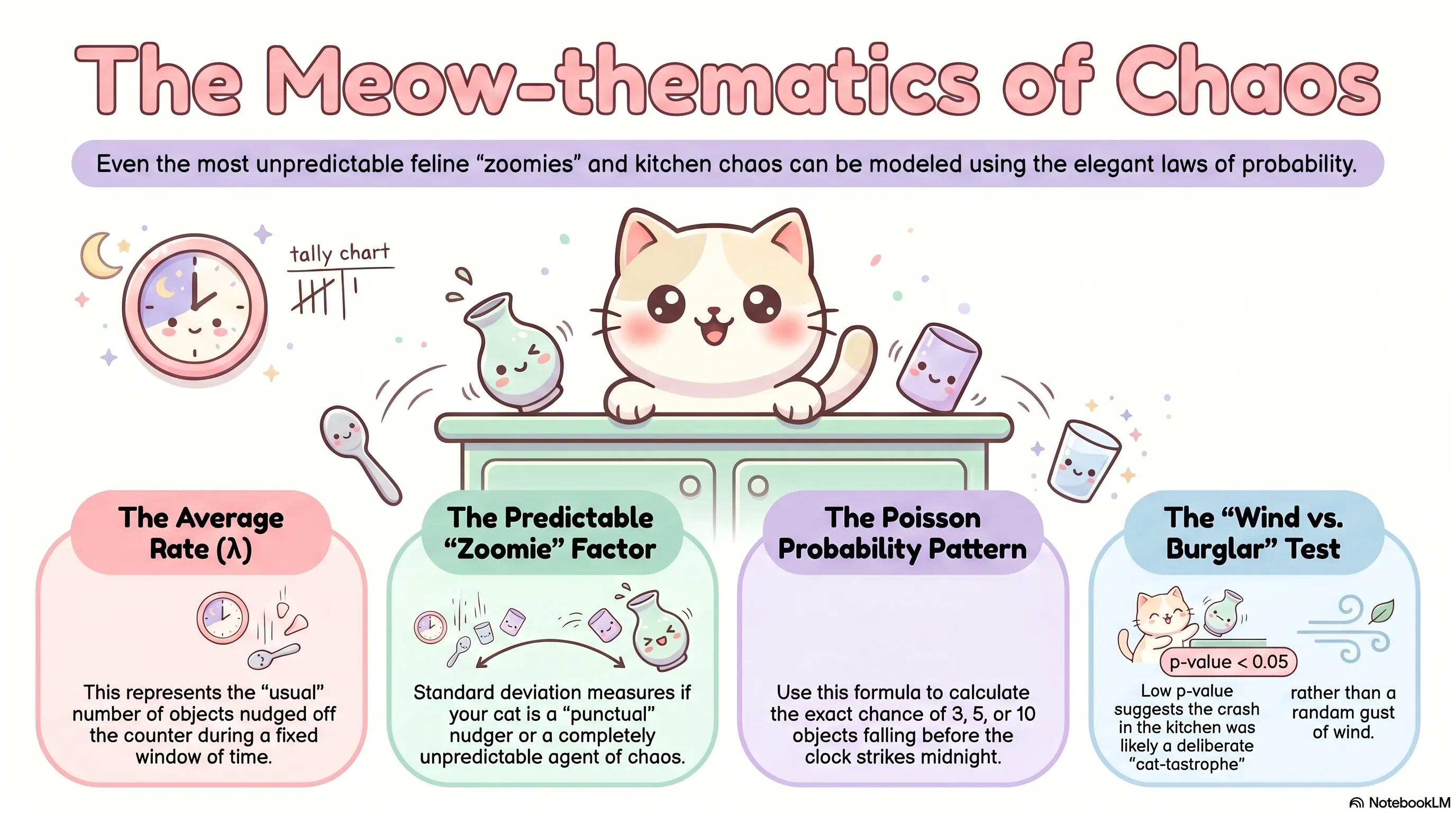
At some point each evening, a cat will knock something off a surface. It won't always be the same thing, and the moment won't always be predictable, but if you tracked it long enough, would offer a clearer picture. Three objects per evening, roughly. Some nights zero. Some nights five. Never a fraction.
The Poisson distribution was built for exactly this situation.
What It Models
The Poisson distribution counts the number of events occurring in a fixed interval of time or space when the events happen independently, at a constant average rate, and cannot occur simultaneously. The interval can be an evening, a square kilometer, or a page of text. The events can be falling objects, radioactive decays, or typographical errors.
The distribution has a single parameter, (lambda), which represents the expected number of events in the interval. Everything follows from .
The PMF
The probability of observing exactly events is:
The factor comes from the Taylor expansion of . The term is the normalizing constant that ensures all probabilities sum to one. Together they produce a distribution defined over all non-negative integers, with no upper bound on .
One useful quantity to internalize: . The probability of zero events decreases exponentially as the rate increases. At , there is about a 5% chance of a quiet evening.
A Worked Example
Assume a cat averages three shelf-clearing incidents per evening, and that these occur independently with no tendency to cluster. We model .
The probability of exactly two incidents:
The probability of four or more:
On roughly one in three evenings, the cat exceeds her average.
Mean and Variance
The Poisson distribution has a distinctive property: its mean and variance are both equal to $\lambda$.
This is not a coincidence of the formula. It reflects the structure of the underlying process. When events occur independently at a constant rate, the spread of the count around its mean grows at the same rate as the mean itself.
This equality is also diagnostically useful. If you observe a count variable whose sample mean and sample variance are approximately equal, the Poisson model is worth considering. If the sample variance substantially exceeds the mean (a condition called overdispersion) the Poisson model is likely inadequate.
Where It Comes From
The Poisson distribution can be derived as a limiting case of the binomial. Suppose you run trials with success probability , and then let while holding $\lambda = npfixed. As $n grows, the binomial PMF converges to the Poisson PMF.
This is not just mathematical trivia. It explains when the Poisson is the right model: when events are rare relative to the number of opportunities, and the count of opportunities is large enough that it no longer meaningfully constrains the outcome. The actual becomes irrelevant. Only the rate survives.
The Poisson Process
The Poisson distribution is the marginal distribution of a more general object: the Poisson process, a model for events occurring continuously in time. In a Poisson process, the number of events in any interval of length follows a Poisson distribution with parameter , where is now the rate per unit time. Events in non-overlapping intervals are independent.
The practical consequence: if you know the rate per hour, you can compute the distribution over any time window by scaling accordingly. The structure is preserved under that rescaling, which makes the Poisson process unusually flexible.
Assumptions and Violations
The Poisson model requires independence and a constant rate. Both assumptions can fail.
Events that cluster, where one occurrence makes another more likely, produce overdispersion. Events that deplete a finite resource, or that have an underlying rhythm (a cat that knocks things over when hungry, and is hungry on a schedule), violate the constant-rate assumption.
When these violations are mild, the Poisson is often a reasonable approximation. When they are severe, the negative binomial distribution is a common alternative: it allows the variance to exceed the mean, and reduces to the Poisson as a special case.
The model is not fragile, but it is not unconditional. Like all probability distributions, it is a description of a mechanism. Whether that mechanism matches the system you are studying is a question about the world, not about the mathematics.
The cats don't charge. The site doesn't either. If something here helped a concept click, a small tip is appreciated.
Buy the Cats a TreatNo PayPal account needed.