
Discrete vs Continuous Distributions: PMF, PDF, and CDF
Morgan Voss·
The distinction matters. Not in the "technically speaking" way that distinctions often matter in statistics textbooks, but in the way that determines which formulas apply, which questions make sense to ask, and whether you are going to be summing or integrating.
Two types of probability distribution. Two different mathematical frameworks. The question that separates them: can the outcome take any value in a range, or only specific, countable values?
Discrete Distributions
When outcomes are countable, we use a Probability Mass Function (PMF), written . Think of it as assigning a weight to each possible outcome. Every outcome gets exactly one value, and no probability spills between them.
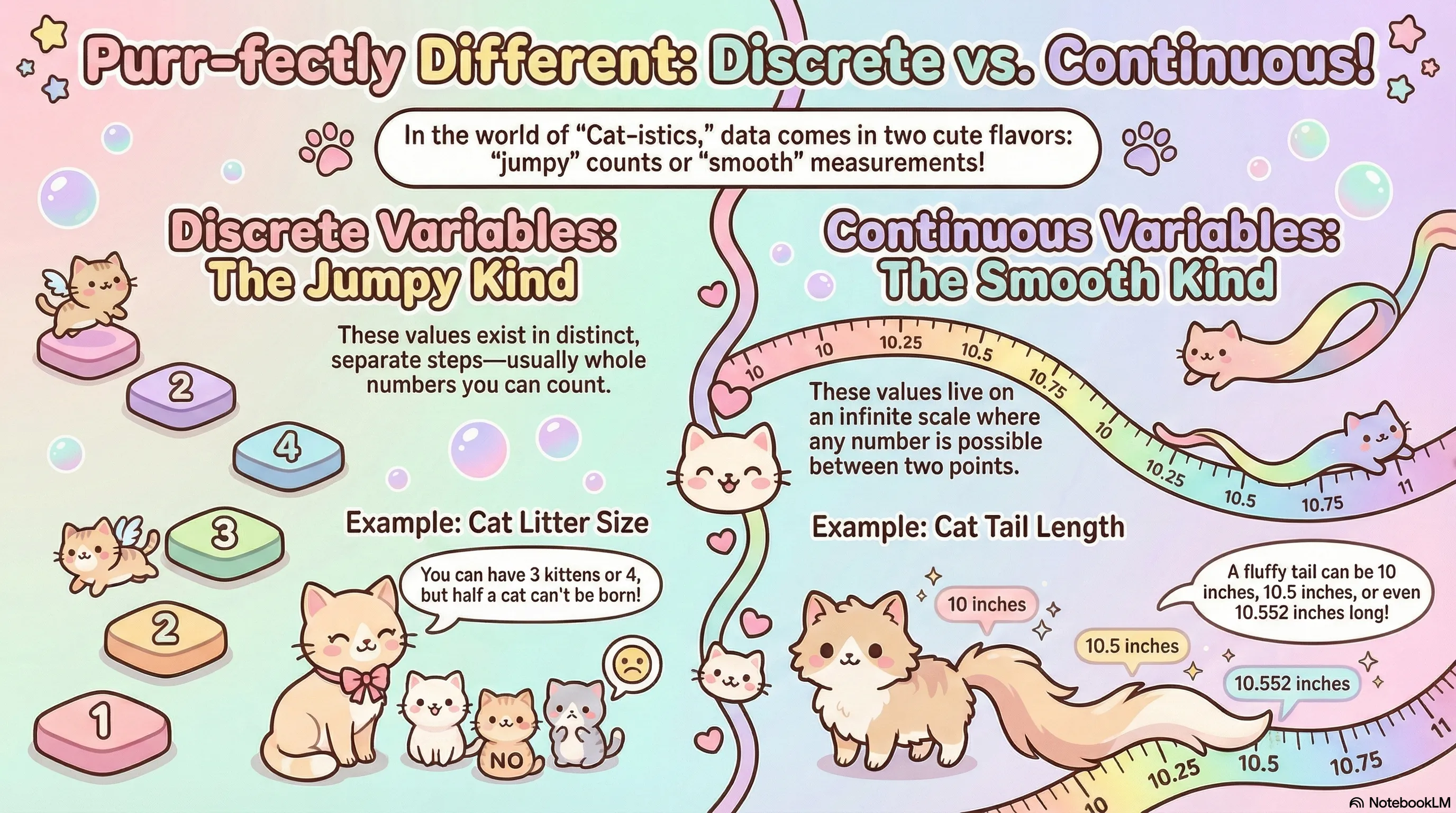
Consider litter size. A particular breed of cat reliably produces between one and four kittens. We can define the PMF directly:
| 1 | 0.10 |
| 2 | 0.40 |
| 3 | 0.30 |
| 4 | 0.20 |
The sum of all probabilities is 1.00. It has to be. Something happens.
The value is exactly zero. Not approximately zero, not negligibly small. There is no such thing as 2.5 kittens. The PMF does not assign probability to values that cannot occur, and so fractions of outcomes are simply not in the domain.
This is the structure that makes discrete distributions tractable: a finite (or countably infinite) list of possibilities, each with an assigned probability, all of which sum to one.
Continuous Distributions
When outcomes can take any value within a range, the PMF breaks down. A cat's tail can be 9.3 inches, or 9.31 inches, or 9.3147 inches. The set of possible values is uncountably infinite. If we tried to assign each one a nonzero probability, the total would be infinite, which violates the entire premise of probability.
The solution is the Probability Density Function (PDF), written . The PDF does not give you the probability at a point. It gives you a density: a rate of probability per unit of the variable. This is a meaningful distinction.
Imagine tail lengths in a colony follow a normal distribution with mean inches and standard deviation inches. The PDF generates a smooth bell curve over that range. The height of the curve at does not tell you the probability that a cat has a tail of exactly that length. The probability of any exact value is zero:
What you can calculate is the probability of landing within an interval, by integrating:
This is the area under the curve between 8 and 10 inches. Area under a density function is probability. This is why continuous distributions require calculus and discrete ones do not.
One more constraint: the total area under a valid PDF must equal 1. The cat has to have some tail length.
The Cumulative Distribution Function
The Cumulative Distribution Function (CDF), written , works for both types. It answers one question: what is the probability that takes a value less than or equal to ?
How that function behaves depends entirely on which type of distribution you are working with.
For a discrete distribution, is a step function. Each time crosses a value with positive probability, the CDF jumps by exactly that amount. In the litter size example:
Plot it, and you get a staircase. Flat between outcomes, vertical jump at each one.
For a continuous distribution, is a smooth, monotonically increasing curve. Because there are no discrete jumps, the function rises continuously from 0 to 1. The slope of the CDF at any point equals the PDF at that point:
This is not a coincidence. The PDF and CDF are related by differentiation and integration in both directions. Understanding that relationship is more useful than memorizing either formula in isolation.
Comparison
| Discrete | Continuous | |
|---|---|---|
| Function | PMF: | PDF: |
| Probability at a single point | Can be nonzero | Always zero |
| Total probability | ||
| Interval probability | Sum over values in range | Integrate over range |
| CDF shape | Staircase (step function) | Smooth S-curve |
The practical consequence is straightforward: know which type you are working with before you reach for a formula. Treating a continuous variable as discrete (or vice versa) does not produce an error message. It produces a wrong answer, which is considerably worse.
The cats don't charge. The site doesn't either. If something here helped a concept click, a small tip is appreciated.
Buy the Cats a TreatNo PayPal account needed.